
It’s the time of year where we all start to think about our social media strategies for 2026. Considering not just micro trends across the platforms, but the macro movements that will help us to stay relevant in a constantly shifting landscape. Below, with none created from ChatGPT I might add, I’ve compiled six trends and predictions for social media in 2026.
1. Feeds fall into the rabbit hole
We’ve moved through many variations of what the “feed” means in social media. First the chronological content feed made up primarily of content from those the user follows, which quickly changed to the algorithmically-designed feed, which uses content-based filtering (CBF). As explained on Wikipedia, “in CBF, a user profile is built to provide information about the types of items that the user likes.”
In 2026 I believe we will be living in a post-feed social media world. Why? Because of two factors: comments and searches.
As we’ve been told time and time again, thanks to stats released by Google, 40% of young people when they’re looking for a place for lunch, go to TikTok or Instagram over Google.
Arguably, social media channels such as TikTok and YouTube are more akin to search engines than social media sites. When users aren’t scrolling the FYP or home feed, they’re placing entries into the search bar. Using social channels as engines to help pull up a curated, keyword and intent-matched set of related content to help them find what to buy, shop or research next.
To cater to this, the channels themselves have started added search-based mechanisms that keeps users falling deeper and deeper into the rabbit hole of the topic they’re researching.
While watching a Molly Mae video on YouTube where she mentions chocolate foundations, YouTube now surfaces this blue linked search in the comments section, leading to other related videos about chocolate fountains.
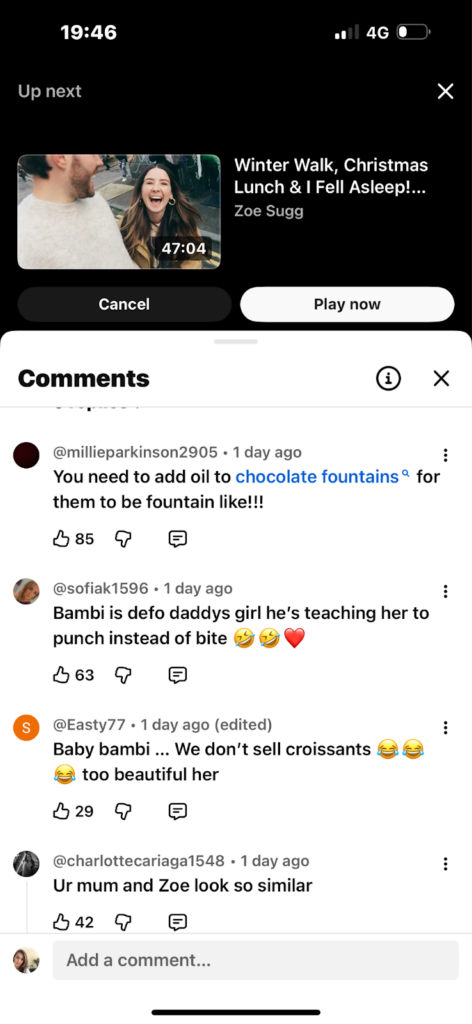
This method of related searches and related comment searches, leads the user deeper into the micro topics they’re interested in. It’s what has made TikTok comments a content stream in itself, with users often commenting on the top comment search that appears beyond the post. With YouTube adopting linked comment searches, and instagram said to also be developing their ability to highlight related comments, the user journey now leaves the feed and falls deeply into the rabbit hole.
What does this mean for brands and business owners? Well, there’s never been a better time to focus on owning your specific product or content pillars on social. Rather than jumping on trends or attempting to reinvent content each time, evaluate the niche topics which you can repeatedly own in a variety of formats across the same content channel. Ensuring that when users do fall into the rabbit hole, they land at your tea party.
2. Return of the grid
Much of the focus in social media strategy is on rented moments – a Reel showing in feed, something appearing on the FYP page. Yet our social media profiles themselves are our own shop window. A place where we can showcase exactly who and what we offer.
Some business owners are now choosing to archive their full body of content, in order to create the grid as a static sales landing page, designed to give a full-body explanation of who they are and what they offer.
Most Instagram users “pin” their most popular content to the top of their grid but this usually showcases what content did well in the algorithm, not who they are or why someone would follow them. Since June, Instagram has been testing the ability to allow users to re-organise their entire grid page, which would lend itself well to the idea of the grid being a landing page designed to attract and convert viewers to followers.
In 2026 I believe brands and business owners will return to their profiles, looking at how they can optimise them to encourage conversion. Using aspects like the bio, the visual impact of the complete page or “grid”, as well as features like highlights, playlists, pinned content and link trees.
Leading to a “return to the grid” approach, focusing on our permanent real estate and the impression that gives, rather than only living in the content moment.
3. Interest-based algorithms create the evergreen content cycle
The rise of interest-based algorithms, where content is supplied not on who you follow but on what you’re interested in, has meant small gains for creators. Previously, content had a 24, or 48-hour cycle at most. Once that cycle was over, the content became the digital version of fish and chip paper. However, due to the rise of interest-based algorithms, content on social media is being allowed to become evergreen.
A piece of content posted two months ago that explains a specific topic or “how to” can be surfaced in relation to a search a user makes on the platform, to a linked comment, or recycled on a quiet day when the endless appetite of the FYP or Explore page can’t be sated.
Since July 2025, Instagram allowed search engines such as Google and Bing to begin indexing content from public Business and Creator accounts, something which TikTok had already allowed. This means that when you run a search in Google (particularly if that search is social media related itself) you can see an Instagram or TikTok post in the search engine results page, answering it for you.
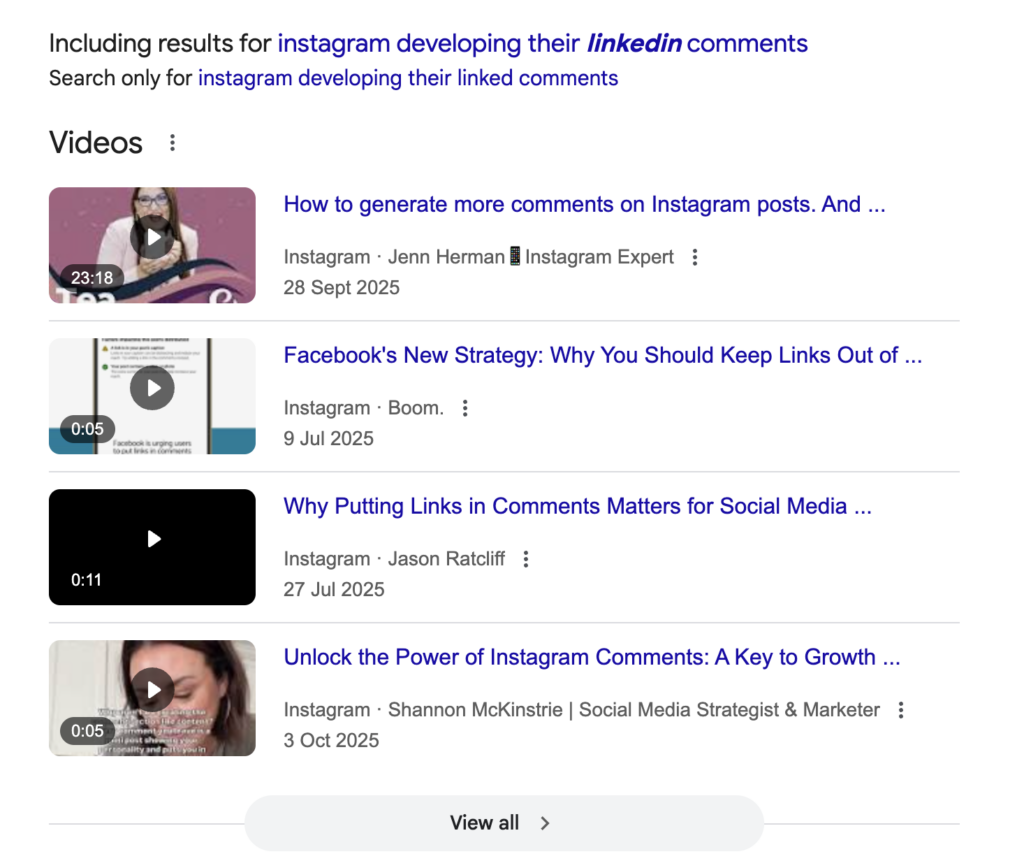
This is great news for brands and business owners who often felt like the effort involved in creating a piece of content wasn’t matched by the reach or results. However, in 2026 we’ll need to consider how this changes what “success” looks like, particularly for agencies, constrained by month-on-month reporting cycles where longer term content value can’t be defined.
It also creates an opportunity for brands in 2026 to harness an evergreen string to their content strategy. Creating videos that focus on how tos, definitions (“what is emotional tapping”), and other forms of evergreen content (a bit like how we used to create our blog libraries) will provide more long-lasting opportunities for visibility. Whilst also informing each algorithm exactly what content you provide, and who it is for. It’s not news that channels such as TikTok, Instagram and YouTube all work quickly to determine a user’s “interests”, before providing content that fits neatly into those categories – TikTok within as little as two hours of a user being on the platform according to some studies.
This year TikTok has released the ability for users to customise the feed to see more oe less of specific topic buckets of content, with Instagram supposedly testing the ability for users to also curate their topics of interest.
Creating evergreen content around the “interest” buckets your content pillars fall into, could help with categorisation, providing double the opportunity to be seen, surfaced, and enjoyed.
4. Comments become a content strategy
People are spending longer in comments sections. Both LinkedIn and TikTok’s UI mean that initial, high-value comments are shown in-feed, or in-post, rather than the user having to click to view. Which means that commenting on content in LinkedIn and TikTok give visibility to you, your profile and your viewpoint. Instagram is a slightly different beast, particularly due to the ManyChat integration “comment NEW to receive the guide” which has arguably ruined the (valuable) comments feed there.
We’ve already seen comments as a content strategy for high-profile brands. John Lewis commenting on any spin-off UGC from its 2025 Christmas ad. Plane, supermarket and mobile phone carrier brands all regularly hanging out in the comments section trying to score points of humour.
In 2026, I see this tricklijng down to smaller creators, brands and business-owners who will use comments as one strand of their content strategy. Either commenting on the posts of others, in order to increase visibility and be seen outside of their own social media bubble, or harnessing their own comment sections to generate new content
Sadly, the rise of comments as a content strategy will also mean an increase in “AI slop”, with some users employing AI tools and automations to rehash the post in question and share this as a comment as part of a visibility grab (already a huge, and annoying, play on LinkedIn). Which means that, like most things to do with AI, truly valuable comments that are either thought-provoking, explanatory or just plain funny, will increase in value and provide better gains than the ones that are average, mediocre or obviously AI-produced.
5. Brands return to full-funnel marketing on social
TikTok is entirely based around a non-follower model. The For You Page (FYP) is designed to deliver an endless stream of curated content – by those you don’t know. Instagram straddles somewhere in between, the Feed makes up a (very) small proportion of content from those you do follow, alongside content from those you don’t. In fact, as part of its filing for an antitrust case with the Federal Trade Commission, Meta claimed that less than 7% of time spent on Instagram involves viewing content from those you actually know:
“Today, only a fraction of time spent on Meta’s services – 7% on Instagram, 17% on Facebook – involves consuming content from online “friends” (“friend sharing”). A majority of time spent on both apps is watching videos, increasingly short-form videos that are “unconnected” – i.e., not from a friend or followed account – and recommended by AI-powered algorithms.”
What I’m not seeing many talk about (but am hearing from almost every agency or single-person business I work with) is the effect this is having on account growth. When your Feed is filled with accounts you don’t know and you don’t follow, users interact with the single-piece of content then move on with their day. Occasionally they may click beyond this to view the profile of that person but the watch > follow ratio is incredibly small. This means that even when your content is receiving even thousands of Views (Instagram’s new master metric), it rarely translates into thousands of followers.
As brands and businesses we need to rethink our growth strategy, moving from a reliance on follower account increases, to an increase in awareness. No longer can we trust that if our content performs, our following will increase. Instead, we have to think more broadly about awareness, defined as ensuring our content (not profile) reaches as many new audience members as possible with in-moment presence. Rather than fixating on that moment turning viewers to followers, we should then think about how we engage and capture audiences into connected audiences. Which may be a “follow”, but likely a subscribe to a newsletter, Broadcast channel or purchase of an item or digital product.
Below is what that model may look like across different channels. Which tells us that in 2026 the consideration surface of social media is a nice-to-have, and what we really need to think about is moving audiences from broad awareness to a specific conversion touchpoint in the way of an email sign-up, a Broadcast channel joining or a direct purchase.
| Channel | Awareness surface | Consideration surface | Conversion surface |
| Feed, Reels tab, Explore tab | Account follow | Stories, Broadcast Channel, Email sign-up. | |
| TikTok | FYP | Follow | TikTok shop purchase, Email sign-up. |
| Feed | Company page follow, newsletter subscribe | Lead gen form completion, website click, event sign-up. | |
| YouTube | Feed, Shorts shelf, Search, recommended videos | Channel subscribe | Website link in description, YouTube Shopping, email sign-up. |
6. Keywords will connect posts (goodbye hashtags)
Instagram has not been quiet about its quest to deprioritise hashtags, with Instagram Head Adam Mosseri repeatedly saying that hashtags do not increase reach on the channel. Despite official Instagram documentation showing a 30-hashtag limit, many users are reporting that their posts are now limited to just three hashtatgs.
Similarly, anecdotal evidence suggests that hashtags now matter less on LinkedIn, and that the text of the post matters more to inform the algorithm what the content is about, and who it’s for. Various TikTok creators report the same: hashtags are no longer a factor in ensuring the virality of your content.
Users still are, and probably will, continue to add hashtags to posts across channels, mainly because they don’t know how else to enable the algorithm to understand and categorise the content they create without them. This is a problem that brands and business owners need to learn to solve; how do I get social media algorithms to understand my content when I can’t add a bunch of random keywords that link the content and explain what it’s about?
Some users have started to “keyword dump” a bunch of interests or topics at the end of Instagram posts. Is this working? Possibly, at least if it’s on Instagram. Despite IG saying it’s investing in the search surface of the platform I’m yet to see any meaningful change in how it understands and ranks content by keywords. On platforms such as TikTok and YouTube, and possibly LinkedIn too, we need to return to understanding search engine optimisation – but this time for social not just web pages. Understanding how to create content that sounds natural, engaging and tells the algorithm exactly what your content is and who it is for, is no easy feat. Search optimisation for social media content is a new skill that everyone will need to master in the year to come, in order to help your content stay connected to various searches, interest groups and topics – without relying on hashtags.
If you enjoyed these predictions, agreed with them, or disagreed please let me know – I’d love to hear your thoughts! Follow us on @gettrendieco.