Australia is set to enforce a youth social media ban active from December 2025, called the Online Safety Amendment (Social Media Minimum Age). This ban will mean that users aged under-16 will not be permitted to use social media platforms such as YouTube, Instagram, TikTok and Snapchat.
It’s been a big story in the news this week, as it means that platforms such as Meta (owner of Instagram and Facebook) and ByteDance (owner of TikTok) will be responsible for creating and maintaining systems to ensure that under 16s can’t make social media accounts. Under the ban, tech companies may face fines if they are not seen to be taking “reasonable steps” to support and uphold the ban within Australia. It’s also been announced that social gaming platforms such as Roblox and Lego Play may also be added to the list.
Despite most Australian parents supporting the social media ban, there are questions on whether this is the right measure to take. Some worry that children will find a loophole in order to continue to chat with friends, and that those sites or methods, may be even less savoury than existing platforms like Snapchat and X. That said, we’re not here to debate whether a social media ban is the right course of action.
Instead, we wanted to share important information that every parent should know if their children or teens are currently, or soon, to be using social media platforms.
How do social media platforms work?
Working in social media means you get a good look at what’s “under the hood” of each social media platform. When I personally scroll on Instagram or TikTok part of me is watching like every user – entertained, enraged or bored, liking or taking in the content. Yet there’s another part of my brain which is analysing. Oh it’s showing me more videos about brown jumpers because I searched for how to style a brown jumper.
This means knowing how to game the system. On Instagram I’ll scroll past videos I’m not interested in because I know the algorithm will stop showing me more of those videos. On TikTok I’ll actively select “Not interested” when a video is shocking or is something I don’t want to see. This type of information is something I believe every parent should have access to, in order to help support their teens, and have open conversations, about how social media works and how it might make you feel or act as a result.
Here are a few key principles that may be helpful for you to know and/or to discuss with your teens:
1. Social media content that goes “viral” is often content which is divisive or shocking
Divisive or shocking content is preferred by algorithms as it leads to lots of shares, comments and conversation (which in turn hooks more people in – the ultimate aim of social media platforms is to keep people on the platform for longer). However, this type of content isn’t always best for us. Negative content, or content which upsets or scares us (and particularly our teens and children) can last well beyond the 15 or 90 seconds the person has seen that content – and once seen, it never goes away.
A recent study looking at the type of content shown on social media to boys aged 11-17 across the United States in July 2025, found that 69% “regularly see masculinity content that promotes problematic gender stereotypes”, for example suggesting that women are only attracted to men who look a certain way.
This, naturally, led to the boys partaking in the study to report that they felg the need to change their appearance. What’s perhaps most troubling, and indicative, of how social media platforms decide which content to promote, is that two thirds of the boys surveyed did not go looking for that content – it simply showed up in their algorithm.
Which shows how content which gets a reaction out of children, whether that’s a positive or negative reaction, is most likely to then be shown to more of that age group (read the full report here).
This is why it can be helpful to open a conversation with our children, asking if they have ever seen something on TikTok or Snapchat which upset them, or made them feel funny, in order to open the conversation and explain why they are seeing that content. Not because it’s “normal”, but because the algorithms prioritise content which is designed to scare, entrance or fuel people.
2. Despite most social media platforms having community guidelines, there is still a lot of harmful or upsetting content that slips through the net
Social media platforms have community guidelines (you can see Snapchat’s guidelines here as as an example). Yet enforcing those guidelines is difficult, and a lot of content slips through the net.
The other day I was scrolling TikTok and a family photo came up of a young girl and her parents. In the caption the user spoke about “MSA”. I had no idea what this term meant, and when I clicked on it, a TikTok explainer popped up saying it stood for “Maternal Sexual Abuse”. This was upsetting for me, as a 35-year old, to see in the middle of a casual scroll one day, so I can’t imagine how upsetting that would be for a child to see, or comprehend.
Acronyms, shortenings and nicknames is just one way that social media users find to get around topics which would usually be restricted by social media community guidelines.
That’s not to say that some topics and personal stories can’t be share online, but there is no seperation from me as a 35-year old seeing that content, and your 13 year old seeing that content. As a piece of content which is upsetting, it’s far more likely to be shown on the For You Page to many users, and a few clicks can take you from a seemingly innocent photo, to a very dark place.
3. Teens can (and should) tailor their algorithm
There are in-built controls on each social platform which allow you to “direct” the algorithm away from content you don’t want to see, or to flat-out report content which is harmful or upsetting. Here’s how to use them on each of the most popular teen platforms:
How to hide or report content on Instagram
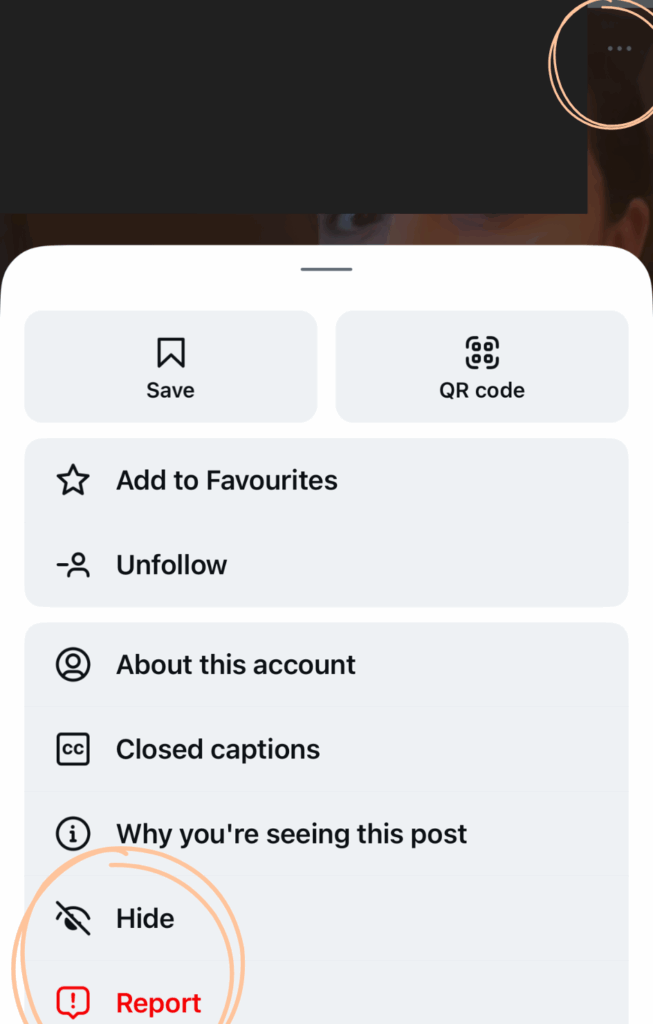
On Instagram you can click the white three dots at the top right-hand corner of any piece of content. By clicking “Hide” you will tell the Instagram algorithm you don’t want to see content that is related to this, or content from this user. By clicking “Report” you can also report that a piece of content has gone against the community guidelines. The person whose content you are reporting or choosing to hide will not know that you have acted on their content in any way.
How to hide or report content on TikTok
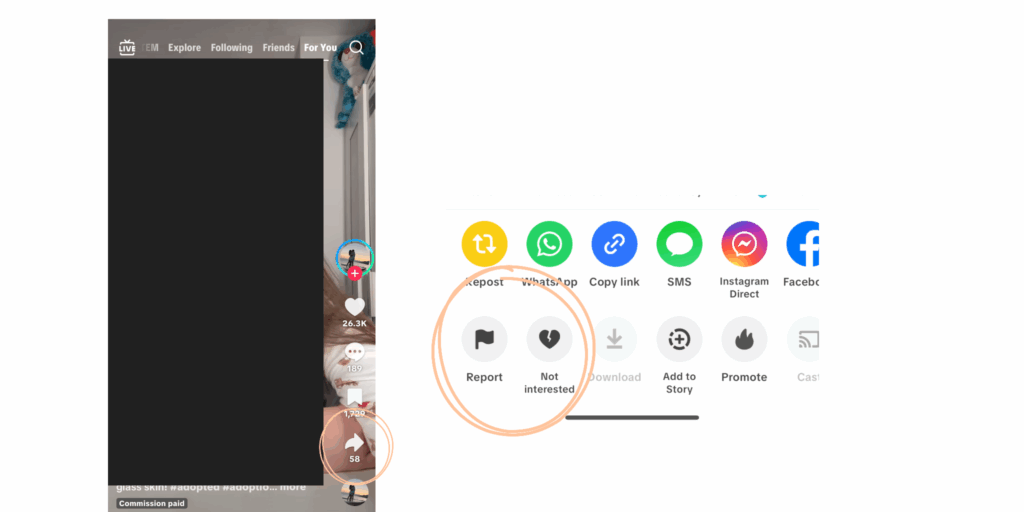
On TikTok you can report content and/or tell the algorithm you are “not interested” in the content you are seeing. First, click the arrow which would allow you to share or send a TikTok, and then you will see the options to either “Report” content if it is harmful or upsetting, or to simply select “Not Interested” to tell the algorithm you don’t enjoy this type of content, so that it shows less of it in your FYP.
How to hide or report content on Snapchat
On Snapchat you can Report public content by clicking the small arrow on the bottom right-hand corner and selecting “Report content”. Snapchat works slightly differently, in that most of the content you see is from people you’re connected with, but you can also “mute” a user’s story and/or message notifications from that user. The user won’t know that you have muted them, but it gives a short (reversible) break from their content or messages rather than having to block or unfriend them.
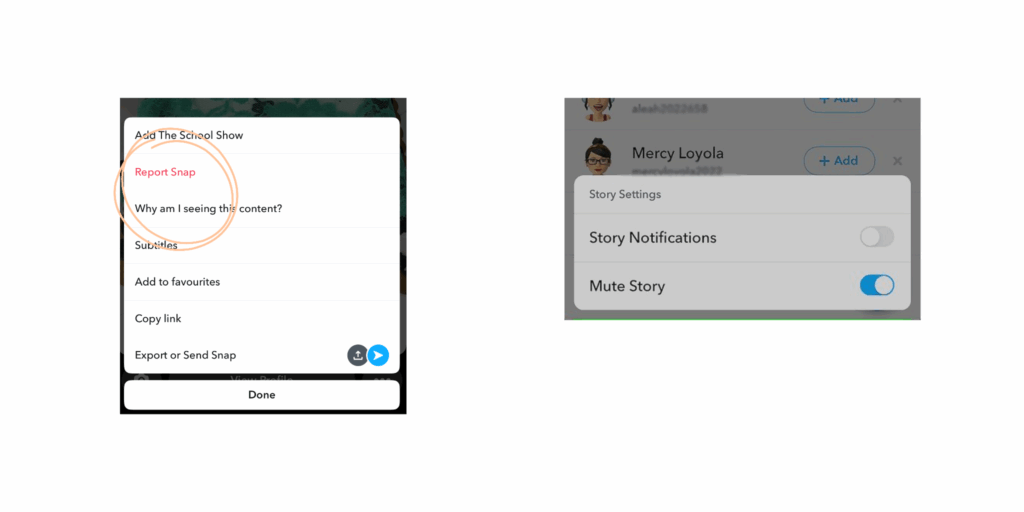
Of course, it is not our childrens’ job to police content, but these can be helpful tools to ensure they don’t have to watch content which they find upsetting. By hiding or ignoring this type of content, their feeds will be filled with more of the stuff they actually do like and want to see. Also, even while knowing about these tools and controls, there is still the question of whether a child or teenager really has the maturity and self-preservation to use them. I certainly don’t think I would have at 13 or 14!
4. Anyone can create a social media platform
To create a social media profile you only need to have an email. You know who can create an email address? Literally anyone.
This perhaps isn’t news but does reinforce the breadth of who could have a social media profile and the world a child or teen is being opened to when they have a social media account themselves. There is some more information in this helpful guide on the impact of this, including what catfishing and grooming make look like, that may be useful to familiarise yourself with.
Working in social media we obviously respect, and enjoy, the social media platforms available. Yet I also believe there is a responsibility to help and support those who do not have access to information about how these platforms work, which often includes parents. I hope this guide has been helpful as a way to help parents feel more informed and to open questions up with the teens around us who are using social media, to ensure we all get the benefits of the platforms without the harm.